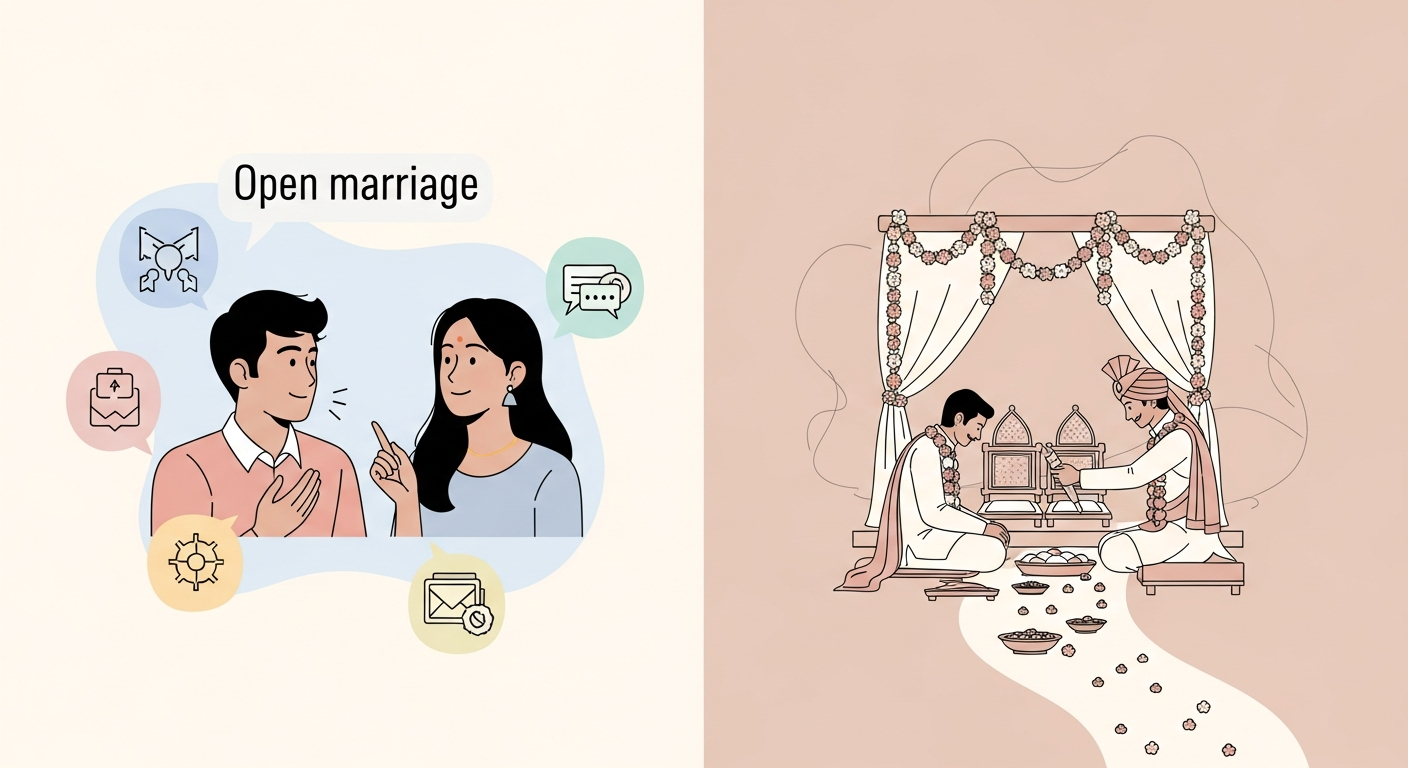
Many young couples in India are struggling to choose between open marriage vs traditional Indian weddings. It may seem easy, but there are utmost unclear thoughts and a communication gap to understand this on a deeper level.
With many silently battling the confusion, they know somewhere deep in their hearts that choosing tradition is giving up their freedom and choosing openness means giving up on their family’s expectations. That fear of losing themselves, mismatched desires and expectations, leaves them in a world of anxiety. In those anxieties, it is more natural to feel lost and confused about which path to choose.
With unclear thoughts due to the family expectations and cultural pressures, choosing one becomes the most difficult decision. Both paths come with deep emotions and different expectations. Most people do not know which path to choose and often make the wrong choice, which can cost them their happiness in life.
This blog will help you understand what your heart is truly trying to say and how the relationship coaching guide can assist you in selecting the right relationship model that genuinely leads to your happiness.
What Are We Comparing? Understanding the Two Relationship Paths
 In a fast-changing country like India, more and more people are looking for love, freedom, stability, and happiness in being together. But when it comes to looking for a blissful and healthy marriage and how it will go on, it really depends on which relationship model you decide to choose—an open or a traditional one. These two models shape your emotional and social life in different ways, so you must carefully choose what you are looking for.
Traditional marriages hold roots and come with rituals and the support of communities. It demands and promises a long-term commitment with stability. Open marriages facilitate clear communication, allow for flexible boundaries, and uphold values of freedom.
If we ask, which path is “better”? Then the answer is, “Neither path is better for anyone.” This system only works well when both partners have a certain level of understanding of what and why they are choosing a particular model. Therefore, when deciding between an open marriage and traditional Indian weddings, it is crucial to approach the decision with the utmost clarity and maturity.
What’s an Open Marriage?
An open marriage is a committed relationship that has clear boundaries and gives them freedom to allow emotional or physical connections with others. These are the principles included:
- Autonomy—personal freedom within commitment.
- Honest communication – regular check-ins
- Negotiated boundaries—rules created together
What Defines a Traditional Indian Wedding/Marriage?
A traditional Indian marriage values the cultural roots and family the most. This commits stability and includes:
- Strong involvement from family and community
- Clear expectations around monogamy and long-term commitment
- High social acceptance and predictable roles
Key Benefits of Each Path
Benefits of Open Marriages
The only conditions for an open marriage are maturity and honesty; if both are present, there are many benefits to consider:
- Personal Autonomy & Freedom
- Enhanced communication & honesty.
- Flexibility & Growth
- Richer Relationship Experience
Benefits of Traditional Indian Weddings & Marriages
Traditional Indian weddings include some of the strongest advantages, which are as follows:
- Cultural and Familial Roots
- Stability & Social acceptance.
- Shared life visions & values
- Predictability & Security
Common Challenges & Misconceptions
 Open Marriage—What Often Goes Wrong or Gets Misunderstood
When you decide to go for open marriages, just make sure that it requires emotional maturity. If not, then it is definite that marriage will go through a struggling phase. Therefore, you must communicate effectively and seek assistance from experts for relationship coaching in open marriages to ensure that the concept of open marriage is clearly understood and managed. These are the common struggles you can face:
- Jealousy, insecurity, or emotional overload
- Weak boundaries or unclear rules
- Social stigma in conservative families
- Pressure from society or fear of judgment
- A belief that open marriages are “just for sex,” which is untrue—they focus mainly on freedom, honesty, and emotional clarity
Traditional Indian Marriage — Limitations & Pressures
Though they come with stability, traditional systems also come with many challenges. These challenges never highlight that this system is wrong, but highlight how much self-awareness plays an important role in successful, healthy relationships.
- Rigid expectations around gender roles
- Family pressure to behave or live a certain way
- Suppressed emotional or intimacy needs
- Fear of disappointing parents or society
- Pressure to maintain image over personal happiness.
The Role of Coaching & Self-Awareness in Making the Right Choice
How Relationship Coaching Helps Explore Values & Desires
You must be thinking, What can coaching do? Coaching does wonders to give you a safe space where you can question and explore your real needs without any pressure or guilt. It gives you better clarity about open marriages vs traditional Indian weddings. Coaching helps in many ways:
- Identify your true values and fears
- Understand emotional needs and long-term expectations
- Explore open marriage models without shame
- Communicate honestly with your partner.
- Navigate confusion around non-traditional relationships
Coaching Tools & Questions to Ask Yourself and Your Partner
These are the common tools used:
- Values-ranking exercises
- Life-vision mapping
- “Deal-breakers vs. non-negotiables” lists
Questions you should always ask:
- How important is family acceptance to us?
- Can we talk openly about jealousy?
- What do we want our lives to look like in 5–10 years?
- What do freedom and commitment mean to each of us?
Decision-Making Framework: How to Decide What’s Right for You
- Clarify Personal Values—freedom or tradition, autonomy or family support.
- Talk Honestly with Your Partner—desires, fears, and expectations.
- Evaluate Maturity & Trust—can you handle difficult conversations?
- Consider Social Context—family acceptance, cultural pressure, and community impact.
- Seek coaching if you feel stuck or conflicted.
Conclusion
In life, there can never be a single “right” answer to any question. In the debate of open marriage vs traditional Indian weddings, both paths have their challenges and benefits. It is always mutual understanding and communication between the partners, clarity, and emotional honesty that determine which will work best for you.
With experts at The Intimacy Curator, you get well-supported guidance where you can clear and explore all the questions in a space that is judgment-free. It always helps in clearing your path privately.
Book a free consultation to start your journey with confidence.