A dispatch on primal play, a video call, and what it means to choose the chase
I interviewed Nina eight months ago for a piece on intimacy and distance in long-term relationships. She was thoughtful and precise and said exactly as much as she wanted to say, no more. At the end of that call she mentioned, offhandedly, that there were things she hadn’t talked about because they weren’t relevant to that piece. I asked if she’d be open to talking about them sometime.
She said she’d think about it.
A few months later she messaged and said she’d talked to her partner Harsh, they’d both be up for it, and would a video call work.
It works. They’re in Pune. The call connects at 8pm their time and I can see, behind Nina, a bookshelf and one corner of a very large houseplant. Harsh is closer to the screen. He has the energy of someone who agreed to this and is now sitting with the specifics of what he agreed to.
They practise primal play. Nina is matter-of-fact about it. Harsh is matter-of-fact about it. I am the only one on this call who takes a moment to settle.
Primal play is a kink built around instinct rather than structure. The easiest way to explain what makes it distinct is to explain what it isn’t. Most BDSM involves choreography: roles assigned in advance, formal titles, protocols, often elaborate gear. A Dom is a Dom from the beginning of the scene. A submissive knows their role before anything starts. Primal play removes most of that scaffolding and asks what remains when you take it away.
What remains, practitioners say, is the body. Chasing, wrestling, biting, scratching, growling, or some combination of those things done until they become their own language between two people. The writer Shannon Ashley calls it honest sex: not optimised for how it looks, both people doing what feels natural and trusting the other to receive it. Masks off.
People often conflate primal play with animal roleplay, where participants take on specific animal personas — a wolf, a cat, a defined predatory identity. They’re related but distinct. Animal roleplay is more theatrical, more scripted. Primal is less about becoming an animal and more about accessing the part of yourself that existed before you learned to moderate it. You don’t have to growl. You don’t have to be anything specific. You just have to stop performing.
“I think about it exactly like that,” Nina says. “Most sex has a performance layer. You’re monitoring yourself, how you sound, whether you’re doing it right. In primal that layer just goes.”
Harsh: “She becomes a completely different person.”
Nina: “He means it as a compliment.”
Harsh: “Obviously.”
Nina grew up in Nagpur. Harsh is from Indore. They met in Pune through work, which neither of them elaborates on, and have been together four years, living together for two. Their families are aware of the living situation and have, as Harsh puts it, “made a kind of peace with it.” The peace involves not asking certain questions. This is a common arrangement in Indian households navigating children who have moved to other cities and begun living in ways that don’t translate well to dinner table conversation.
Kink, in India, exists almost entirely online. There isn’t much of an offline community to speak of, no munches, no events in most cities, no visible infrastructure. What exists is people finding vocabulary for their desires through international forums and Reddit threads, and then quietly looking for each other in comment sections and DMs. Nina came across the term through a BDSM community online. She sat with it for a while before she brought it to Harsh, because she’d had no language for what she wanted before that and she wanted to be sure she was using the right one.
“I knew something was being held back,” she says. “In sex I was always managing. Moderating. And I didn’t know that was the problem until I read a description of what it would feel like if it wasn’t.”
Within primal communities, people who identify this way often describe it less as a kink they practise and more as a quality they have. The vocabulary reflects this: practitioners call themselves primals, and speak about their nature rather than their preference. Online communities use the language of packs, with Alphas tending toward dominance and roles like predator, hunter, and prey marking the spectrum. What makes primal structurally different from standard Dom/sub dynamics is that these roles are often genuinely contested rather than pre-assigned. A predator can be pinned. A prey can turn. The power is something that happens in the room, not something agreed on before entering it.
She brought it to Harsh the way she does most things, she says, which is with research. Harsh says this meant a structured document with multiple points. Nina says it was notes. I believe Harsh.
The conversation they had before anything physical happened is the part of primal play that people outside the community most consistently underestimate, partly because the dynamic looks, from the outside, like the absence of negotiation. It is the opposite. Because primal scenes get physically intense and involve an altered headspace where the rational brain is genuinely less accessible, most experienced practitioners negotiate more carefully than people who do more structured kink, not less. What Nina and Harsh covered: what each of them wanted, what was off-limits, any physical injuries or sensitivities to work around, and how they’d stop if needed.
The safeword problem in primal play is practical: once you’re in it, you’re often not speaking. A verbal safeword that requires you to pause, surface a word from memory, and say it clearly is not always usable in the middle of a scene that has gone somewhere wordless. Their solution is three firm taps anywhere on the other person’s body, borrowed from wrestling’s tap-out, practised beforehand until it would be automatic rather than something to remember under pressure.
“You have to make the boring parts reliable,” Harsh says, “or they don’t work when you need them.”
Before a scene starts there’s a phase practitioners call circling. Both people in the room, both knowing what’s about to happen, reading each other without saying anything. Where the other person’s weight is. Whether they’re loose or tense. Whether they’re actually present.
This phase does more work than it looks like it does. In more scripted BDSM, consent happens in the negotiation beforehand, and then the scene proceeds. In primal play, circling functions as real-time consent reading: you’re checking, without asking, whether the other person is genuinely there. Whether they want this tonight, in this moment, with this energy. The scene only starts when both people can read that answer as yes.
“If he’s distracted, I can tell immediately,” Nina says. “There’s nothing to read. And if there’s nothing to read, nothing happens.”
“It’s happened a couple of times,” Harsh says. “We just didn’t start. Watched something instead.”
Roles aren’t fixed. It isn’t simply that he chases and she runs. The power shifts with the scene, which is one of the defining features of primal play relative to other dynamics. The genuine contestedness of it, the fact that either person can end up pinned, is a significant part of why people are drawn to it over more formally structured alternatives.
“I don’t want to just win,” Harsh says. “I want to earn it.”
Nina: “He doesn’t always earn it.”
Harsh, without apparent distress: “She’s faster than me.”
There’s a question that sits at the centre of this piece and I don’t want to route around it.
India has one of the highest rates of reported crimes against women in the world, a fact the NCRB documents consistently and grimly each year. In August 2024, a trainee doctor was raped and murdered inside a hospital in Kolkata, a building she was supposed to be safe in, and women across the country went out into the streets at night to protest because the alternative was silence, and they had already tried that. Every Indian woman I know navigates a version of the same calculation daily: which route, what time, who to call, where to be. The threat is not metaphorical. It is not historical. It is a Tuesday.
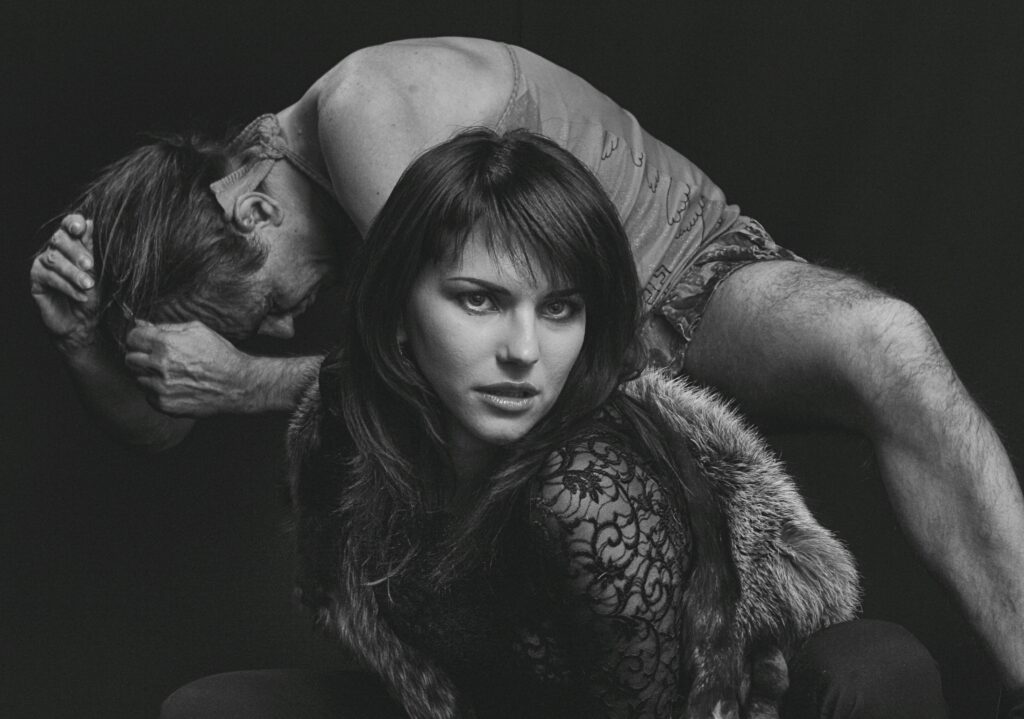 Nina, who lives inside all of this, has chosen a dynamic in which her partner hunts her.
She’s quiet when I put it to her. Not uncomfortable. She has thought about it.
“I’ve thought about it a lot,” she says. “Because it’s not a neutral image, a man chasing a woman in this country. It has real weight here. It has happened to people I know, in ways that had nothing to do with desire and everything to do with violence.”
Harsh doesn’t interrupt.
“What I kept coming back to was the difference between something happening to you and something you choose. In primal play, I set the terms. I designed the conditions. The chase only exists because I made space for it, and it ends however I decide it ends. That’s not how it works in the world.”
She pauses.
“I also think there’s something in taking back the shape of it. The hunt, the being caught, these are things that have been done to women without consent for all of recorded history. And I wanted to take that exact shape and fill it with something I chose. Something that ends on my terms.”
She looks directly at the camera.
“I can’t fully separate it from the context I live in. I’m an Indian woman. That context is inside me. But I think the choosing is what makes it different. And I needed to trust that difference before we started. To trust myself to know which thing was which.”
Harsh, quietly: “We took a long time with that part.”
Nina: “A long time.”
An important distinction that practitioners are consistent about: in consensual primal play, the person taking the dominant role carries an ongoing responsibility to read the other person’s actual state, not just their role within the scene. Body language, breathing, genuine distress signals override everything. The scene is not more important than the person in it.
Primal play is physical in a way that most kink isn’t. It’s closer to wrestling than to anything else under the BDSM umbrella, and the recovery can be proportional. Harsh pulled a hamstring their third time. The bruise visible on Nina’s forearm, which she holds toward the screen when she notices me noticing it, is from last weekend.
The physical protocols matter and are worth knowing in detail. Biting is very common in primal play. The general guidance in practitioner communities is to target fleshier areas, upper arms, thighs, and stay away from bony areas, joints, and especially the neck, where pressure can interfere with breathing. The goal is sensation and mark, not broken skin, and controlling pressure is a skill that takes practice and explicit conversation beforehand. Scratching follows similar logic: which areas, how deep, how visible the marks can be given work and social circumstances. Keeping nails trimmed and clean matters because human nails carry bacteria and primal scenes sometimes break skin.
None of this is romantic. All of it is necessary.
“We have a first aid kit in the bedroom now,” Nina says.
“We had one before,” Harsh adds. “Now we know where it is.”
They’ve also moved furniture. The physical space for primal play needs to be cleared of actual hazards before a scene: sharp corners, breakable things, anything that becomes dangerous when two people are moving fast and not attending to room layout. Harsh and Nina have rearranged their flat accordingly, in ways they’ve never explained to visiting family, who presumably attribute it to taste.
The comedown after an intense primal scene is something practitioners call sub-drop or just drop, and it can be significant. The adrenaline, the physical exertion, the concentrated attention required all have a descent on the other side, and aftercare is not optional. Nina goes quiet after a scene for fifteen or twenty minutes. Not sad. Recalibrating. Re-entering language, coming back to the part of herself that uses words and makes ordinary conversation.
“He used to try to check in immediately,” she says.
“She didn’t want to be talked at,” Harsh says.
“I just needed to be near him. Not asked anything.”
When she’s ready, she wants tea and she wants to talk through everything. Harsh makes the tea. The debrief, by the sound of it, is thorough.
“She tells me everything,” he says, with the tone of a man who finds this genuinely good.
Physical aftercare sits alongside this: rehydrating, eating something, tending to any marks. Primal play is a real physical exertion and treating the body accordingly is not overcaution. Some practitioners note that the drop can arrive not immediately but hours or even a day later, which is worth knowing the first few times.
There’s a piece of science that keeps coming up when people write about primal play, and I find it more useful than most of the explainer content around this subject. In the 1970s, social psychologist Dolf Zillmann developed what he called excitation transfer theory: the finding that residual physiological arousal from one emotional state can intensify a subsequent, unrelated emotional response. The sympathetic nervous system arousal produced by fear, elevated heart rate, faster breathing, heightened sensitivity, decays slowly enough that it can bleed into the next stimulus and amplify it. In specific circumstances, the central nervous system interprets this residual arousal as sexual. The body, in other words, doesn’t always know the difference between being frightened and being turned on. It knows it’s activated, and works with what’s in front of it.
It’s why horror movies have always had a reputation as date movies. It’s why the specific quality of adrenaline that comes with being chased can become something else entirely.
“That tracks for me,” Nina says, when I bring it up. “I grew up watching a lot of horror with cousins. We’d argue about whether the fear was good fear or bad fear.”
She looks at Harsh.
“I think I always knew it was both.”
Near the end I ask what they’d want someone to know who was curious but couldn’t quite picture themselves in it.
“That it doesn’t have to look like what you’re imagining,” Nina says. “You don’t have to growl. You don’t have to chase anyone through a forest. It can just be fully present, fully physical, with nothing being performed. That’s the actual thing.”
Harsh: “Do the boring work first. The conversation, the negotiation, all of it. People think structure kills the wildness. It’s the other way around. You can only really let go when you trust the container.”
“And you will be awkward the first time,” Nina adds. “Something will go wrong or be funny and you’ll both laugh. That doesn’t break anything. The mood in primal is very hard to kill, because some chaos is already the baseline.”
Before I let them go I ask Nina whether it’s strange, doing this call with someone who previously interviewed her about something else entirely.
“The first piece was about intimacy too,” she says. “Just a different kind. Once you’ve talked honestly about one private thing, the next private thing is less frightening. You know the shape of the conversation.”
I think about the first interview. Nina precise and careful, saying exactly as much as she wanted to say. This conversation has not been careful in that way. It has been specific and honest in the way that things get when you have stopped deciding what to let through.
Harsh reaches across, off-camera, and I don’t see what he does exactly. Nina looks at him and then back at the screen.
“Okay,” she says. “I think we’re done.”
They are.
Nina was previously interviewed for The Intimacy Curator. Both names changed.